

When a Tooth Has to Go —
We Make It Easy
Whether it's a damaged tooth, an impacted wisdom tooth, or one that's just too far gone to save — we handle it with precision, care, and a whole lot of gentleness. Most patients are genuinely surprised by how manageable it is.

Common Reasons a Tooth Needs to Come Out
Our first priority is always to save your natural tooth if it's realistic. But sometimes extraction is the right answer — and we'll tell you honestly which it is. Read: Does my tooth need to be extracted? →
Severe Decay
When a cavity has progressed too far for a filling or crown to fix it, extraction prevents the infection from spreading to surrounding teeth and bone. We'll always evaluate whether a root canal is viable first.

Cracked or Fractured Tooth
A crack that runs below the gum line often can't be saved — and leaving it can lead to painful infection. If a vertical root fracture is confirmed on 3D imaging, extraction protects your jaw and adjacent teeth.

Impacted Wisdom Teeth
Wisdom teeth that haven't fully erupted, are growing at an angle, or are crowding neighboring teeth are one of the most common reasons for extraction. Catching them early — before pain starts — makes the process much smoother.

Panoramic X-ray showing impacted wisdom teeth — a common finding we evaluate with full-arch imaging before planning any extractions.
Infection or Abscess
If a tooth infection has spread to the bone or root and can't be resolved with antibiotics or a root canal, extraction removes the source. Untreated, abscesses can become a serious health issue quickly.

Active infection draining from a cracked tooth — at this stage, extraction is the most conservative path to resolving the infection completely.
Crowding or Orthodontic Preparation
Sometimes creating space is the key to a healthier, straighter smile. Removing one or two teeth can unlock orthodontic results that braces or aligners alone can't achieve.
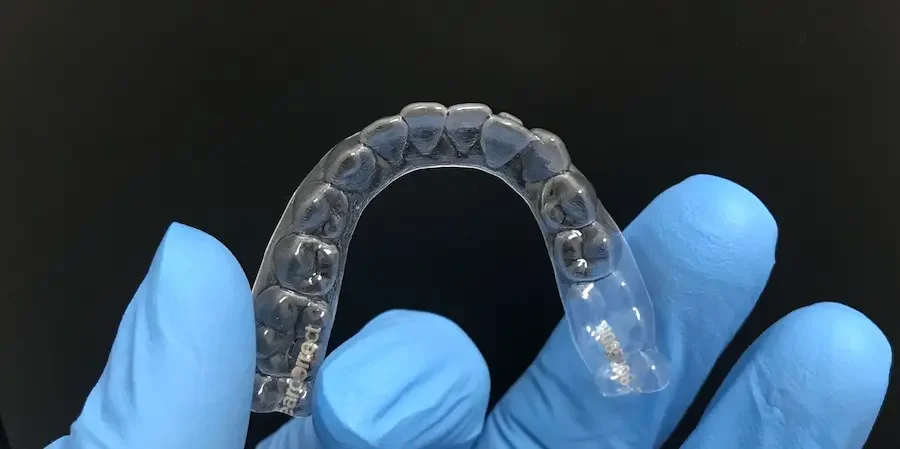
Strategic extraction to create space, combined with clear aligner therapy — a treatment path we coordinate in-house.
Failed Restoration or Root Canal
When a previously treated tooth fails — crown comes loose, root canal retreatment isn't viable — extraction and replacement is often the most predictable long-term solution available.

Failing root canal with active infection — extracted and replaced with an implant at our office. See the full case →
What Your Tooth Pain Is Telling You
Not all tooth pain means extraction — the type of pain often points directly to the cause and what can be done about it. Written by Dr. Brayden Teuscher. Full guide →
Extraction is always a last resort, not a first option. If a tooth can be predictably saved, we save it. Read the full guide from Dr. Brayden →
Simple vs. Surgical Extractions
The type of extraction depends on the tooth — we'll tell you exactly which one applies to your case during your consultation.
Simple Extraction
For a fully erupted, single-rooted tooth that can be removed intact with forceps — typically front teeth, canines, or premolars. Local anesthesia numbs the area completely. Most patients report feeling pressure, not pain.
- ✓Single appointment, 30–60 min
- ✓Local anesthesia, fully numb
- ✓Recovery: 24–72 hours
- ✓Back to normal activity next day for most
- ✓Sedation available if desired
Surgical Extraction
Required for teeth with multiple roots, broken-down teeth, or any tooth that needs to be sectioned to come out cleanly. Most molars fall here. More involved — but with careful planning and technique, still very manageable.
- ✓3D CBCT imaging beforehand
- ✓Local anesthesia + sedation options
- ✓Tooth sectioned when needed for cleaner healing
- ✓Sutures placed, follow-up included
- ✓Bone graft option same visit
What Happens During a Tooth Extraction Appointment
No surprises. Here's exactly what to expect from consultation to recovery.
Consultation & 3D Imaging
We take a CBCT scan and examine the tooth, surrounding bone, and nearby nerves. You'll know exactly what type of extraction is needed, what to expect, and what the plan is for the site after — before anything is scheduled.

X-ray of a tooth prior to extraction — 3D CBCT imaging lets us see roots, nerve proximity, and bone health in full detail before we plan anything.
⏱ 30–45 minAnesthesia & Sedation Setup
We take our time getting you fully numb — and we won't start until you are. If you've chosen oral sedation, it's taken about an hour before your appointment. Most patients are pleasantly surprised by how relaxed they feel by the time we start.
⏱ 15–30 minThe Extraction
You'll feel pressure and movement — but not pain. Dr. Brayden works efficiently and precisely, guided by the 3D imaging done at your consult. For surgical cases, the tooth may be removed in sections for a cleaner result and better healing.
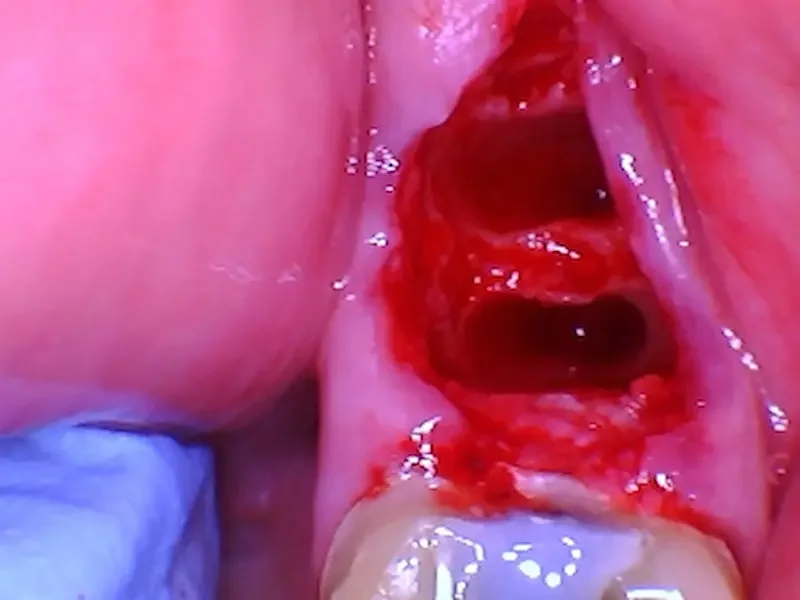
The socket immediately after gentle extraction — careful technique maintains intact bone walls, which is critical if a bone graft or future implant is planned.
⏱ 20–60 min depending on complexitySocket Care & Bone Graft (If Applicable)
If you're planning to replace the tooth with an implant, we place a socket preservation bone graft at the same visit. The socket is filled with biocompatible bone material and covered with a collagen membrane and sutures — protecting the bone and setting you up for the best possible implant outcome.

Collagen plug over bone graft, with sutures in place

X-ray showing socket filled with bone graft material
Recovery Instructions & Follow-Up
You leave with clear written aftercare instructions. We see you at one week for a brief post-op check and suture removal. Most patients are back to their routine within 1–3 days after a simple extraction.
⏱ Follow-up at 1 week · bone heals over 8–12 weeks if graftedA Real Extraction & Bone Graft at Teuscher Legacy Dental
Dr. Brayden documented a real patient case from start to finish — including X-rays, clinical photos, and the bone graft procedure. No stock photos.
Infected Cracked Tooth — Extraction & Bone Graft
A tooth with a vertical crack had developed active infection draining into the surrounding tissue. Not restorable — extracted with a socket preservation bone graft placed same visit.

Dr. Brayden documented this full case — including the 8-week CBCT scan showing regenerated bone, and the eventual implant placement. See the complete walkthrough on the blog.
Read the Full Case Study →Does My Tooth Need to Be Extracted?
Three questions. Honest guidance. Not a substitute for a real exam — but a good starting point.
A Consultation Will Tell You for Sure
Based on your answers, this sounds like something worth getting looked at. The good news: a consultation is low-pressure and commitment-free. Dr. Brayden will give you an honest evaluation — including whether the tooth can be saved — and walk you through every option. Sedation is available if anxiety is a concern.
Book a Consultation →What to Expect After Your Extraction
We send you home with written instructions and we're reachable if questions come up. Here's exactly what we tell every patient.
Bleeding & Day 1
Bite down on gauze for 30–45 minutes. Always wet gauze before placing or removing it. Apply ice 15 minutes on, 15 minutes off. Light oozing for up to 48 hours is normal.
Managing Discomfort
A rotating protocol of 600mg ibuprofen and 500mg Tylenol every 4 hours typically provides better relief than a narcotic. We prescribe pain medication when needed.
Eating & Drinking
Soft, cool foods for the first few days — yogurt, smoothies, eggs, mashed potatoes. Avoid anything hot, crunchy, or spicy. No straws — suction can dislodge the clot.
Oral Hygiene
Brush and floss normally, avoiding the extraction site for 24 hours. After 24 hours, gentle warm salt water rinses (½ tsp salt in 8 oz water) 2–3 times daily. No vigorous spitting.
Watch For Dry Socket
Dry socket (dislodged blood clot) is uncommon but uncomfortable. If pain increases after day 3 instead of improving, call us — it's an easily treated issue. Avoid smoking for at least 48–72 hours, which significantly increases the risk.
Healing Timeline
Gum tissue closes over 1–2 weeks. If a bone graft was placed, we see you at one week for a brief check and suture removal. Bone fully heals over 8–12 weeks before an implant can be placed.
What Are Your Options for Replacing the Tooth?
Extraction is only the beginning. The bigger decision — the one that shapes your long-term oral health — is what comes next. How soon after extraction can I get an implant? →
Dr. Brayden Teuscher, DMD
Dr. Brayden has a clinical focus in extractions and dental implants — and he's performed more extractions than most general dentists in Kane County. He approaches each case the same way: with thorough 3D imaging, clear communication, and a gentle technique that consistently surprises patients who came in nervous.
What makes his extraction approach different is the planning behind it. CBCT imaging is standard at our practice — not an upgrade. Before a surgical extraction, he sees exactly where the roots are, where the nerves run, and what the bone looks like. He's published real case walkthroughs of extractions and bone grafts on the blog — including step-by-step photos of actual procedures — because transparency is part of how we practice.
If an implant is in your future, he places and restores those in-house too — which means the extraction, bone graft, and eventual implant are all planned together from the start, not piecemealed across three different offices.
"My job isn't just to remove a tooth. It's to make sure you leave knowing exactly what happened, what to expect, and what your options are going forward — with no anxiety about any of it."
— Dr. Brayden Teuscher, DMD
Walk In Before You Walk In
Anxious about the office? Take a look around first. Knowing what to expect starts before you arrive.
A quick walk through our St. Charles, IL office — so you know exactly what you're walking into.
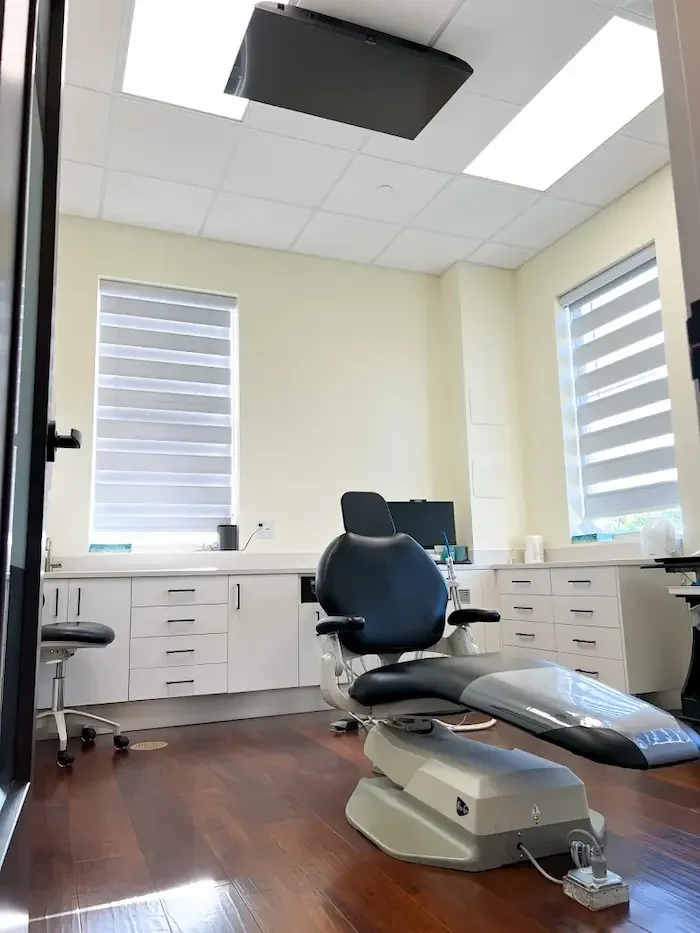
The operatory where extractions are performed

Relax in Teuscher Legacy Dental's cozy reception area
From Nervous to "That Wasn't So Bad"
Our most common post-extraction feedback? Patients wishing they'd come in sooner.
"Dr Brayden Teuscher and his team are amazing. Had a bad broken tooth. He had my tooth out in seconds. Literally didn't feel anything… I thought they were kidding me when he said it was over. The office was super clean. Staff greeted me the moment I walked in. I highly recommend that if you have difficult teeth issues that you make an appointment with Teuscher Legacy Dental — their care and experience was one of a kind. I will never be going anywhere else."
"Dr. Brayden did a wonderful job with my tooth extraction and bone graft. He was very thorough explaining everything and was there for questions afterwards. The entire staff is awesome at Teuscher Dental!!! My entire family loves going here."
"This place deserves all the stars, and then some! Had my wisdom tooth extracted pain-free and without hesitation. Dr. Brayden is a miracle worker. There's no better dentist out there!"
"I was terrified going in but the whole team made me feel so comfortable. Dr. Brayden talked me through every step. Easiest dental experience I've had, honestly."
Everything You Want to Know About Extractions
In-depth articles written by Dr. Brayden — not by AI, not by a marketing firm. So you can make an informed decision, even if you never become our patient.
My Tooth Hurts — Does It Need to Be Extracted?
A pain-type diagnostic table plus Dr. Brayden's honest framework for deciding whether to save or extract a tooth.
Real Bone Graft Case: How We Preserve Bone After Extraction (Part 1)
Actual X-rays and clinical photos from a real case at our practice — walking through every step of an extraction and socket preservation graft.
Do I Need a Bone Graft After a Tooth Extraction?
Research-backed breakdown of when a bone graft is recommended, when it's optional, what it costs in Kane County, and what the studies show about bone loss without grafting.
How Soon After an Extraction Can I Get a Dental Implant?
Immediate, early, and delayed implant placement explained — with a breakdown of bone graft types, healing timelines, and what determines which path is right for your case.
Tooth Extraction Questions — Answered
Honest answers to the questions we hear most often.
With proper anesthesia, you should feel pressure and movement — not pain. We take our time getting you fully numb before starting, and we won't proceed until you are. Post-procedure soreness is typically well managed with a rotating ibuprofen/Tylenol protocol — which often provides better relief than a narcotic. Oral sedation is also available for patients with dental anxiety, which makes the entire experience much more manageable.
For a simple extraction, most patients are back to their normal routine within 24–48 hours. Surgical extractions (impacted wisdom teeth, complex roots) typically take 3–5 days to feel normal again. We see you at one week for a brief post-op check and suture removal. If a bone graft was placed, the graft heals over 8–12 weeks before an implant can be placed — but most patients feel back to normal well before that.
If there's any chance you'll want an implant in the future, the answer is almost always yes. Once a tooth is removed, the bone in that area begins to resorb within weeks — studies show up to 50% of ridge width can be lost in just the first 8–12 weeks without grafting. A socket preservation graft placed at the time of extraction protects that bone and keeps your implant options open. At our practice it's $936 and includes the membrane, sutures, and follow-ups. We'll discuss whether it makes sense for your specific situation. Full guide: Do I need a bone graft? →
Our first priority is always to save your natural tooth if it's viable. In some cases, a root canal and crown is the right answer. In others, the tooth is too damaged, infected, or structurally compromised to be saved — and extraction is actually the more conservative long-term choice. We'll give you an honest evaluation, not just a quick path to a procedure. Full guide: Does my tooth need to be extracted? →
At Teuscher Legacy Dental, a simple extraction of an adult tooth is $326. Surgical extractions of adult teeth are $494. A socket preservation bone graft placed at the same appointment is $936 — which includes the membrane, sutures, and follow-ups. We review all fees before we ever start, and there are no hidden costs. Insurance often covers a portion of extraction fees. CareCredit financing is available. See our full pricing page →
The three main options are a dental implant (the most permanent and bone-preserving option), a dental bridge (fixed, but requires modifying adjacent teeth and doesn't prevent bone loss), or a removable partial denture (the most affordable but least stable). We'll walk through all three at your consultation. Full side-by-side comparison of all options →
It depends on your case. Some patients qualify for immediate implant placement — the implant placed the same day as the extraction (most often possible with single-rooted teeth and no active infection). Others need 8–12 weeks of early healing first. Cases with significant infection or bone loss may need 3–6 months before placement. We'll tell you clearly which timeline applies to you and why. Full guide: Implant timing after extraction →
Yes. Adult oral sedation is available for patients who want to be more relaxed during their procedure. You'll need a driver, and you'll want to plan to take the rest of the day easy — but many patients who come in anxious say it's the reason they were finally able to go through with it. Let us know at booking if sedation is something you'd like to discuss.
Dry socket occurs when the blood clot that forms in the extraction site gets dislodged before healing is complete — exposing bone and nerve tissue. It's uncomfortable, but treatable. To avoid it: no straws, no smoking for at least 48–72 hours (smoking significantly increases risk), avoid vigorous spitting or rinsing for 24 hours, and stick to soft foods. If you experience increasing pain after day 3 instead of improvement, call us — it's easily treated at our office.
Yes. Dr. Brayden handles the majority of wisdom tooth extractions in-house, including impacted cases. Using 3D CBCT imaging, he assesses root shape, nerve proximity, and impaction angle before the procedure — making surgical planning more precise and the extraction more predictable. Complex cases involving the inferior alveolar nerve or unusual anatomy are evaluated individually to determine the safest approach.
Ready to Stop Putting It Off?
A consultation with Dr. Brayden is low-pressure and commitment-free. You'll leave knowing exactly what needs to happen, what it'll cost, and what your options are — no anxiety required.
Schedule a Consultation →Serving St. Charles · Geneva · Campton Hills · Elburn · Elgin · All of Kane County
Teuscher Legacy Dental · 40W131 Campton Crossings Dr, St. Charles, IL 60175 · (630) 762-0000