

What Does an Extraction Bone Graft Look Like 1 Week After Surgery?
Edited February 4th, 2026
One of the most common questions patients ask about 1 week after a tooth extraction with a bone graft is:
“Is this what it’s supposed to look like?”
If you’re about one week out from an extraction and bone graft, this article will show you exactly what normal healing looks and feels like, using real patient clinical photos from our St Charles, Illinois dental practice.
Quick orientation: Where You’re at 1 Week Post Op (Bone Graft Healing Timeline)
Days 1-3: Blood clot, swelling, early inflammation
Days 5-6: Transition to early granulation tissue (If you aren’t quite 1 week out, start here!)
Week 1: Granulation tissue forms (what you’re seeing now)
Weeks 2–3: Gum tissue strengthens, color normalizes
Months 1-4: Bone begins to consolidate
Months 4–6: Implant readiness (case dependent)
About the author
This article was written by Dr. Brayden Teuscher, a general dentist with a surgical focus on tooth extractions, bone grafting, and dental implants in St. Charles, IL, serving Kane County, Campton Hills, Geneva, Elburn, and surrounding communities.
Why This Tooth Needed an Extraction and Bone Graft
This case involved tooth #19, a lower molar that had a large infection caused by a crack on the back (distal) side of the tooth.
Before the tooth was removed, there was a draining sinus tract, which means the infection had been present long enough that the body created a small channel to release pressure and bacteria.

X Ray before Extraction. Notice the darker area around the roots of the molar- that’s where the infection is.

Picture of the back side of the tooth. Notice the crack in the center of the tooth. This is the infection’s source. And the pimple to the right side is where the pus from the infection is draining out of the gums.
Once the tooth was removed, the infected tissue inside the socket was physically cleaned out. This step is critical—bone grafts only work when infection is thoroughly removed first. The long term plan is to replace this tooth with a dental implant. We do this all the time for patients in Kane County, Illinois. An antibiotic was also prescribed after surgery to support healing once the infection source was eliminated.
Not every tooth extraction requires a socket preservation bone graft. And, at one week, the grafted site is far from fully healed. In fact, while socket preservation reduces alveolar ridge bone collapse, bone remodeling and maturation still continues for months, but the evidence is clear socket preservation maximizes the chances at maintaining bone volume (Byrne GJ et al. Socket preservation of implant sites — Journal of the American Dental Association (JADA). 2012)
What Type of Bone Graft Was Used?
After cleaning the socket, a bone graft was placed to help preserve bone and support future healing.
In this case, the graft included:
70/30 cancellous to cortical bone particulate
Cancellous bone helps new bone form more quickly
Cortical bone helps maintain strength and volume
A collagen plug placed on top of the graft
A PTFE suture in a figure-8 pattern to hold everything stable
This is a very common approach after extracting an infected molar, especially when preserving bone for possible future implant placement.
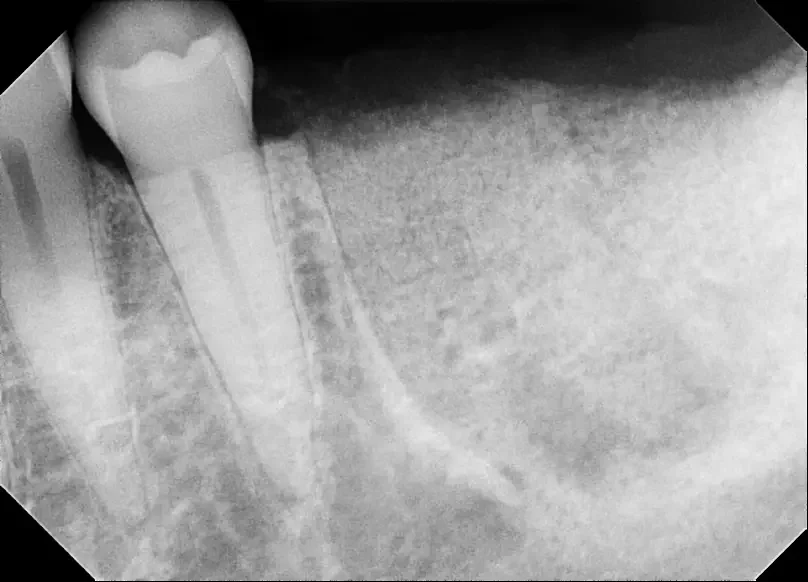
X Ray showing where the tooth used to be, now filled with bone graft particles after extraction at Teuscher Legacy Dental.

Photo immediately after extraction and bone graft. The shiny red is a collagen material used to help blood clot over the graft. The sutures blend into that material. The draining infection to the right side of the graft was cleaned out physically after the tooth was extracted.
What Does an Extraction Bone Graft Look Like After 1 Week?

One week after extraction and bone graft, the gums are closing over the hole where the tooth used to be. The white appearance inside the crater can be alarming, but it is normal healing of the gum and bone graft. Here you can see the figure 8 of the stitches more clearly. Typically we remove these stitches after 1 week.
At one week post-op (or even 8-10 days later), the extraction site looked exactly how we expect healthy healing to look.
Most patients notice:
A small crater or hollow where the tooth used to be
A white or off-white material inside the socket
Gums that are slowly healing inward, but not fully closed yet
That white appearance is normal. It is not pus or infection.
It usually represents:
Healing tissue
Residual collagen material
Early bone formation happening underneath
At one week, the gums are not supposed to be fully closed yet.
How Should an Extraction Bone Graft Feel After One Week?
In this case—and in most similar cases—patients report:
Significant relief once the infected tooth is removed
Mild soreness rather than sharp pain
Gradual improvement each day
Many patients are surprised that they feel better after the extraction than they did before, especially when a chronic infection was present.
Bonus Resources: What Does an Extraction & Bone Graft Look Like 2 Weeks After Surgery?
What Does an Extraction & Bone Graft Look Like 1 Month After Surgery?
Is Pain Normal After an Extraction Bone Graft?
Some soreness is normal, especially during the first week.
For many patients, pain is well managed with over-the-counter medications.
When safe for the patient, a common approach is:
Ibuprofen 400–600 mg
Four hours later: Acetaminophen (Tylenol) 500 mg
Continue rotating every four hours as needed
This combination helps control both inflammation and discomfort without stronger medications.
(Always follow your dentist’s instructions and confirm these medications are safe for you.)
When Should You Be Concerned?
While a crater-like appearance and white healing tissue are normal at one week, you should contact your dentist if you notice:
Increasing pain instead of gradual improvement (especially throbbing pain)
Swelling that worsens after day 3–4
Foul taste or active drainage
Fever or feeling unwell
These are not typical signs of normal healing.
The Big Takeaway: This Is Normal Healing
At one week after an extraction with a bone graft:
The site often looks open
The graft is working underneath the surface
Gums heal slowly and intentionally
Bone regeneration takes months, not days
Healing doesn’t look “pretty” early on—but that doesn’t mean something is wrong.
Remember, that healing will take a matter of months. But it’s often worth the wait: Studies indicate significant long-term positive effects on alveolar ridge height and volume when socket preservation is used compared to extraction alone (Atieh MA, Alfardan L, Alsabeeha NHM, et al.Alveolar ridge preservation after extraction: systematic review and meta-analysis. PubMed. 2022).
If you’ve been told you need a bone graft or you’re wondering whether your extraction site looks normal, these are exactly the kinds of questions we want patients to ask. In our St Charles, Illinois dental practice, we hear these questions all the time.
Clear answers reduce anxiety—and better understanding leads to better healing.
If you’re in the Kane County, IL area, come see us for a free consult!